
Functionalization of Electrospun Nanofibers for Rare Metal Recovery
The report is based on a collaborative research visit between researchers from the University of the Western Cape (UWC), Department of Chemistry, South Africa and Missouri University of Science and Technology (Missouri S&T), Department of Mining & Explosives Engineering, USA during the 1st quarter of 2026.
Collaborators
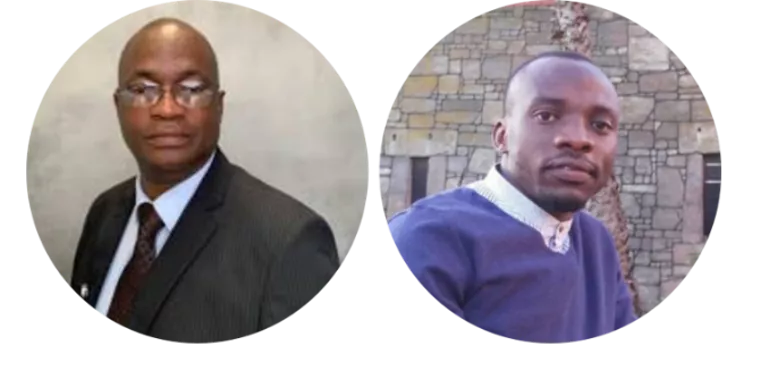
- UWC: Dr. Alechine E. Ameh (Research visitor) & Associate Professor Keagan Pokpas
- Missouri S&T: Dr. Olanrewaju Fatoba & Professor Kwame Awuah-Offei (Host)
Executive Summary
This report summarizes the outcomes of a three-month research visit undertaken by Dr. Alechine Ameh to the Missouri University of Science and Technology (Missouri S&T), USA. The visit focused on developing functionalized electrospun nanofibres for the selective recovery of critical and rare metals from aqueous systems while strengthening an established international collaboration between Missouri S&T and the University of the Western Cape (UWC).
The visit resulted in the successful fabrication and preliminary functionalization of electrospun nanofibres, the acquisition of valuable experimental data, and the exchange of expertise in electrospinning, adsorption science and advanced materials characterization. Beyond the research activities, the visit strengthened institutional partnerships, established new interdisciplinary collaborations, and identified several opportunities for future joint publications, postgraduate student exchanges and collaborative research funding.
Background to the Collaboration
The collaboration between the Department of Chemistry at the University of the Western Cape and Missouri University of Science and Technology has developed over several years through strong professional relationships between the participating researchers.
The partnership was initially established through Dr. Ameh’s longstanding academic relationship with Dr. Olanrewaju Fatoba, who co-supervised his MSc research in the Environmental Nanosciences (ENS) research group at UWC and has remained an active research collaborator. More recently, this collaboration expanded to include Professor Kwame Awuah-Offei to deepen mutual academic and research interests. Since then, interactions between our research groups have continued to grow, creating opportunities to combine expertise in materials chemistry, environmental remediation and mining engineering.
The research visit was conceived to strengthen this international partnership through the exchange of scientific knowledge, the development of complementary technical expertise, and the establishment of a multidisciplinary research programme focused on the sustainable recovery of critical metals. The collaboration aligns closely with UWC's strategic objectives of expanding international partnerships, increasing research impact, enhancing postgraduate training and developing collaborative research programmes that address global sustainability challenges. Specifically, the aim was to expand materials preparation and functionalization of Electrospun nanofibers for diverse applications relevant to low-income communities.
Introduction
The recovery of rare earth metals using functionalized electrospun nanofibers has emerged as an eco-friendly approach to reclaiming essential critical metals (including Ni, Co, Nd, and Li) needed for clean energy systems. Conventional mining and extraction processes are associated with significant environmental impacts, motivating the development of alternative recovery technologies that support resource circularity and a sustainable low-carbon economy.
Electrospun nanofibres have emerged as promising adsorbent materials. The high surface area, tunable porosity, and tailored surface chemistry of electrospun nanofibers enable highly selective and effective adsorption of rare earth elements from aqueous environments. This method promotes resource circularity, mitigates ecological degradation linked to traditional mining, and aids in the advancement of sustainable metal recovery technology. Chemical functionalization of these nanofibres enables selective adsorption of target metal ions, making them attractive materials for recovering valuable metals from complex aqueous environments.
The main focus of the research was on the functionalization of electrospun nanofibers to enhance their capacity for selectively recovering metal ions from aqueous systems. The work combined electrospinning, surface functionalization, advanced materials characterization and adsorption studies to establish a platform for efficient and sustainable metal recovery. The motivation for this work is the rising demand for efficient, low-cost, and sustainable methods for the recovery of important rare earth elements from industrial wastewater and secondary resources.
Research Outcomes and Key Achievements
The research visit yielded several important scientific, collaborative and training outcomes:
Design of Electrospun Nanofibers and Functionalization
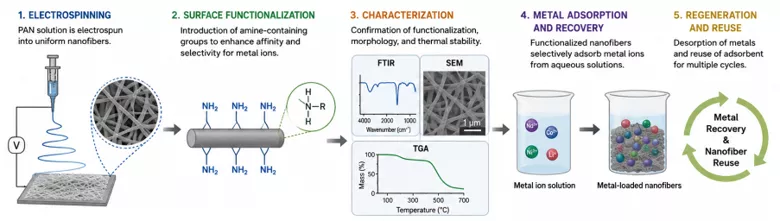
Nanofibers were synthesized through electrospinning methods. Herein, PAN was electrospun into nanofibers via electrospinning in DMF, considering the following parameters: concentration of PAN (wt%), collection distance, and voltage. Afterwards, a preliminary study was carried out on the grafting and surface-treatment procedures, introducing functional groups such as amines (using different wt%) onto fiber surfaces. These adjustments were aimed at improving the adsorption capacity, selectivity, and reusability.
Characterization of Functionalized Nanofiber
A range of analytical techniques were applied to confirm the successful functionalization and to characterize the material characteristics. These included spectroscopic approaches (FTIR), surface morphology analysis (SEM), and heat stability testing (TGA). The results confirmed successful insertion of functional groups and gave information about structure-property links.
Studies on Metal Adsorption and Recovery
Batch adsorption studies were performed to evaluate the efficacy of the functionalized fibers for the removal/recovery of metal ions from solutions. The functionalized nanofibers showed promising adsorption capacity and selectivity. Other parameters such as pH, contact time, starting metal concentration, and competing ions will be extensively examined after the functionalization optimization process of the nanofibers.
Key Achievements
- Successful training on electrospinning equipment and the fabrication of Electrospun nanofibers with reproducible morphology.
- Preliminary functionalized the developed electrospun nanofiber surfaces using amine-containing ligands to enhance metal adsorption and characterized these through various spectroscopic and microscopic techniques.
- Preliminary adsorption studies demonstrating proof-of-concept for the selective recovery of target metal ions from simulated aqueous solutions.
- Collection of quality experimental data, suitable to inform onward study and optimization processes.
- Strengthened partnership with academics and graduate researchers at Missouri S&T
- Identification of future areas of research, including zeolite synthesis with Dr. Hany El-Azab's research group.
- Establishment of a strong foundation for joint publications, collaborative grant proposals and future postgraduate research projects.
Knowledge Exchange
A noteworthy outcome of the research visit was the successful transfer of knowledge, technical skills, and research techniques between the University of the Western Cape and Missouri University of Science and Technology. The research visit incorporated practical expertise in advanced electrospinning techniques, optimization of nanofiber production parameters, and chemical surface functionalization approaches designed to enhance rare metal adsorption efficiency. Exposure to different experimental approaches and laboratory practices has broadened my technical capabilities and will directly enhance ongoing research activities within the Department of Chemistry at UWC.
The collaboration also provided an opportunity to share expertise developed at UWC in nanomaterials synthesis, environmental remediation and adsorption chemistry. Scientific discussions with faculty members, research staff and postgraduate students facilitated the exchange of ideas, refinement of experimental methodologies and identification of complementary areas of expertise that will benefit future collaborative projects. The visit fostered professional networking through interactions with researchers across Missouri S&T and engagement with the wider Rolla community, further strengthening the long-term partnership between the two institutions.
Beyond my research activities, I have established relationships with the community via the Rolla Church of Christ, where I have found a welcoming and supportive community that has provided meaningful opportunities for socialization, friendship, and service.
Benefits to the University of the Western Cape
This collaboration has generated significant benefits for the Department of Chemistry and the University of the Western Cape. The visit has expanded the Department's expertise in electrospinning, nanofibre functionalization and sustainable adsorption technologies, complementing existing strengths in analytical chemistry, nanomaterials and environmental remediation. The knowledge acquired during the visit will be incorporated into ongoing postgraduate research projects and future research initiatives within the Department hosted by Prof. Pokpas. The collaboration also strengthens Dr. Ameh and Prof. Pokpas’ international research profile by establishing an active partnership with Missouri S&T in an emerging area of strategic importance. Access to complementary expertise, specialized instrumentation and multidisciplinary research capabilities creates opportunities for enhanced postgraduate supervision, staff development and collaborative research.
Future Collaborative Opportunities
Future work will focus on optimizing nanofibre functionalization, improving adsorption capacity and selectivity, and evaluating the recovery of a broader range of critical metal ions from complex industrial wastewater matrices. The experimental findings generated during the visit will hopefully support several joint peer-reviewed publications and form the basis for future collaborative funding applications. Discussions during the visit further identified opportunities to collaborate on functionalized zeolite materials and other advanced adsorbent systems, broadening the scope of the partnership beyond the current project.
Summary
The three-month research period at Missouri S&T proved to be very productive and intellectually stimulating. The visit centered on the advancement and functionalization of electrospun nanofibers for the selective recovery of rare metals from aqueous environments, addressing the increasing global need for sustainable resource recovery methods.
During the research visit, electrospun polyacrylonitrile (PAN) nanofibers were effectively produced and underwent initial surface functionalization with various ligands to improve adsorption performance. Thus, confirming successful surface modification and providing valuable insights into the relationship between material structure and adsorption properties. Preliminary adsorption studies demonstrated promising potential for the selective recovery of rare metal ions, establishing a strong foundation for subsequent optimization studies.
In addition to the technical accomplishments, the visit notably enhanced institutional partnerships, promoted the sharing of scientific knowledge, and identified new interdisciplinary research opportunities, including future work on zeolite synthesis and advanced functional materials. The research visit enhanced technical proficiency in nanofiber production, surface modification, advanced characterization, and adsorption science, while also expanding collaborative research networks. Overall, the visit strengthened scientific collaborations, joint grant proposals, and continued innovative solutions in sustainable materials and environmental chemistry.