
Introduction
My name is Denise Brown, and I am a fourth-year PhD Candidate in Political Science in the Harry Truman School of Government and Public Affairs. In Fall 2025, I was awarded the Henry Mitchell Scholarship in support of doctoral research examining the electoral decline of national liberation movements turned dominant political parties in Southern Africa. In May 2026, I spent four weeks conducting fieldwork at the University of the Western Cape (UWC), where I was hosted by the Department of Political Studies and facilitated by the Institute for Poverty, Land and Agrarian Studies (PLAAS). The award has proven among the most significant experiences of my academic development, helping me think through a research agenda that will shape the coming years of my scholarship and lay the groundwork for a tenure-track career. In this report, I document the research question animating the field research, the methodological approach, the principal findings, and the next steps emerging from this period of work. The report is structured accordingly.
Research Overview
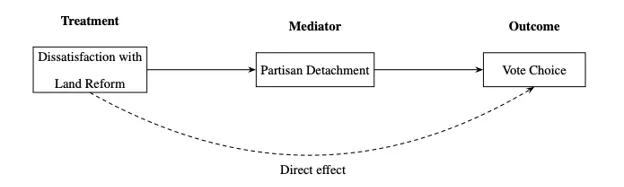
The central argument of my research is that national liberation movements turned dominant political parties lose support when they fail to deliver on their foundational promises, most centrally the promise of land redistribution. Unlike earlier nationalist movements in Sub-Saharan Africa and the Caribbean, which won independence through negotiated withdrawal, liberation in settler colonies such as South Africa, Namibia, and Zimbabwe followed a far more contested path. Where white minority regimes refused to cede power, nationalist movements turned to armed struggle as the only route to freedom. This mode of resistance generated broad popular support, carrying these movements into power as dominant ruling parties at independence. I argue that they lose that support through a two-stage process: first the erosion of partisan attachment, and then the weakening of electoral support (see figure 1). This idea first took shape during an earlier and much shorter visit to South Africa in Spring 2025. The fieldwork sought to explore that intuition, that the failure to deliver land redistribution can account for the ANC's decline. The question was particularly important as an earlier iteration of the project had undergone review at a leading political science journal, where the principal critique centered on a problem of identification, namely how the decline could be attributed to land redistribution specifically, rather than to competing grievances.
Methodology

The fieldwork was exploratory in nature, designed to complement the quantitative core of the project with direct, on-site engagement. Because the individual is the unit of analysis, I sought to understand how ordinary South Africans think about land reform, how they assess the ANC's performance, how they regard alternative parties, and how they orient themselves toward electoral participation more broadly. Much of this engagement took place in informal settings, where I raised questions and listened to a wide range of perspectives, from students at the University of the Western Cape to security guards, restaurant servers, and other members of the public who were eager to share their views. I also had the opportunity to conduct a series of elite interviews with faculty in the Department of Political Studies and with researchers at the Institute for Poverty, Land and Agrarian Studies (PLAAS), whose expertise on land reform and agrarian change speaks directly to the project. Most importantly, the fieldwork included time in Khayelitsha with the Politics and Urban Governance Research Group, based in the Department of Political Studies. Among the largest and fastest-growing townships in South Africa, Khayelitsha is an informal settlement, overwhelmingly poor, and thus offers a vivid setting in which to examine attitudes toward land redistribution. Across these engagements, I spoke with approximately 70 to 80 individuals. Images 1 and 2 capture daily life in Khayelitsha.

Findings
The fieldwork was clarifying to the theoretical mechanism I proposed. The trip reinforced my initial account, namely that partisan detachment, rather than dissatisfaction alone, drives support for opposition parties. Without this rupture in the affective bond between voter and party, opposition gains would not materialize. Many residents remain deeply disappointed with the ANC yet show little appetite for the alternatives. For many Black South Africans, still marginalized and still waiting on the promises of transformation, the choice is not between the ANC and another party but between the ANC and abstention. When the ANC disappoints, the more common response is to disengage from politics altogether.
This led me to think more carefully about other grievances, such as unemployment and corruption, and I came to realize that the same mechanism governs them regardless of the policy domain. It is not the grievance itself that moves voters toward alternatives, but the breaking of the affective bond. A voter can be deeply dissatisfied with the ANC's record on jobs, on crime, on corruption, or on land, and still return to the party at the ballot box, so long as the underlying attachment holds. The grievance only becomes electorally consequential once that bond has already ruptured. I suspect, however, that land redistribution may exert the strongest pull of these, given its foundational place in the liberation promise.
A second point that became apparent is how closely the failure of land reform is tied to these other grievances, even though the connection is not immediately identifiable. The lack of land reform has contributed to high unemployment in regions like the Eastern Cape, driving migration to the Western Cape and the proliferation of informal settlements. However, when asked about their problems, citizens rarely think of land reform at first. This has been especially illuminating for my project, sharpening my intention to trace how these grievances radiate outward from land.
Next Steps

The paper is currently being revised for submission to Democratization, a Q1 peer-reviewed journal in political science. Beyond this immediate step, I intend to develop the project in a comparative direction, setting South Africa alongside Zimbabwe. The two countries began on a similar trajectory but diverged sharply in their approach to land reform, with South Africa pursuing a market-led, willing-buyer willing-seller model and Zimbabwe ultimately turning to radical land seizures. Does political behavior differ among citizens depending on the land reform strategy their government pursued?
Acknowledgements
Overall, it was an enriching experience, and one I could not have undertaken without the Henry Mitchell fellowship. I am grateful to the Department of Political Studies and its head, Professor Cheryl Africa, who ensured my time there extended well beyond the research itself. I had the opportunity to witness my first ever citizens' assembly, taking part in the mock proceedings ahead of the real event held in October 2026. I also attended a talk by the Cuban ambassador, as well as a land reform seminar hosted by PLAAS together with members of the United Nations. It was a truly remarkable few weeks, and I have missed it very much since, particularly my morning walks and lunches from Simply Asia. I owe a tremendous thank you to Professor Uphoff for the incredible role he played in making this trip such an enjoyable experience, from arranging my accommodation and flights to making introductions on my behalf. I cannot imagine the experience without him.