
Decrypting the Nonlinear Universe
The UM/UWC Linkage Program in 2025
PI: Shun Saito (Missouri S&T)
Co-I: Roy Maartens (UWC)
Collaborators: Bikash Dinda (UWC)
1. Background and Goals
The ultimate goal of cosmological observations is to deepen our knowledge of fundamental physics. All ongoing and future cosmological observations are designed to achieve key science goals such as revealing the origin of cosmic acceleration, weighing neutrino masses, and inferring the very early universe dubbed the cosmic inflation. The large-scale structure of the Universe is identified as a key probe to tackle these scientific questions. The cosmology groups at S&T (led by Saito) and UWC (led by Maartens) have highly complementary expertise in the large-scale structure and are heavily involved in ongoing and forthcoming experiments of the large-scale structure. Maartens’s group at UWC has been leading 21cm intensity mapping experiments including MeerKat and the Square Kilometer Array (SKA). Saito’s group has an official data access to the Hobby-Eberly Telescope Dark Energy Experiment (HETDEX) and officially joined in the Project Infrastructure team of the Nancy Grace Roman Space Telescope, NASA’s next flagship space mission, in Fall 2023. The goal of this project is 1) to investigate important theoretical questions focusing on various nonlinearities in the large-scale structure of the Universe in light of these relevant experiments, and 2) to further promote and expand the collaboration between the two groups, following our successful initiation of the collaboration supported by previous UMSAEP supports since 2020. The highlight of activities and outcomes of the entire project can be found below.
2. Scientific highlight
Bottom line
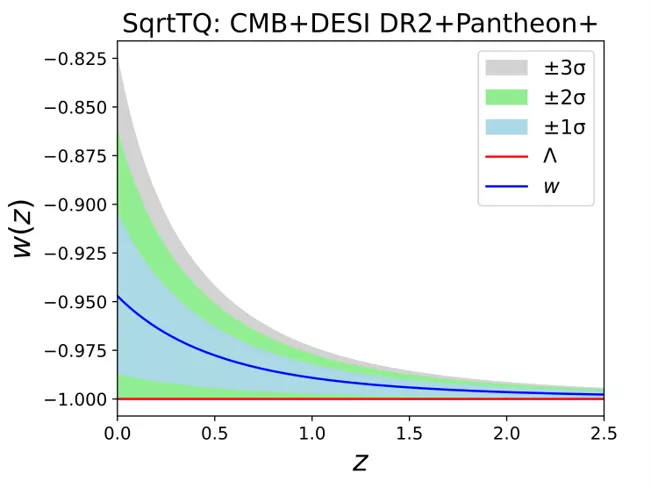
Cosmic acceleration is one of the biggest mysteries in fundamental physics, which we attribute to an unknown energy component called dark energy. Some recent data combinations fit models with changing dark energy slightly better than the standard cosmological constant model, but that advantage usually disappears when the models are compared across their full range of possibilities. Current observations do not provide consistent evidence that dark energy changes with time or crosses into a “phantom” regime. Our paper is under review for Physical Review D;
Dinda, Maartens & Saito, “No evidence for phantom crossing,” arXiv:2605.13546.
Why this question matters
In the standard cosmological model, dark energy is a cosmological constant: its properties do not change with time. New measurements from the Dark Energy Spectroscopic Instrument (DESI), when combined with maps of the early Universe and observations of exploding stars, have prompted suggestions that dark energy may instead evolve. One striking possibility is “phantom crossing,” in which its behavior passes through the value associated with a cosmological constant. Confirming such an effect would point to new physics and reshape our understanding of the Universe.
What the team did
We compared the standard model with two broader classes of explanations: a flexible mathematical description that can produce phantom crossing, and physically motivated “quintessence” models in which dark energy evolves without entering the phantom regime. We analyzed multiple combinations of DESI’s second data release, cosmic microwave background measurements, and several independent supernova samples. Crucially, we went beyond asking which model gives the single best fit. We used Bayesian model comparison, which tests performance across all allowed parameter values and penalizes added complexity that the data do not actually use.
Why the result is important
The study shows why an intriguing best-fit result is not, by itself, a discovery. A robust claim must remain persuasive across datasets, reasonable model choices, and global statistical comparisons. For now, the standard cosmological model remains viable, while physically motivated alternatives also remain allowed. The work provides a careful framework for evaluating future DESI and supernova measurements as their precision improves—and for deciding when evidence for new cosmic physics is truly strong.
3. Dr. Dinda’s visit at S&T in April 2026
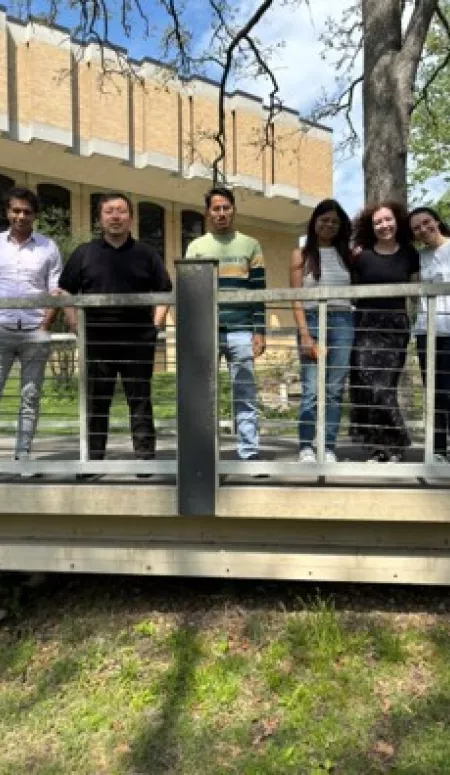
Following the proposed plan, Dr. Bikash Dinda, a postdoc at UWC and a collaborator in this project, visited Saito’s group at Missouri S&T in April 2026. This is his second visit and his visit went extremely smoothly thanks to Dr. Uphoff.
In addition to the significant outcome of our collaborative work mentioned in Sec. 2, Dr. Dinda kindly gave a seminar talk entitled “No evidence for phantom crossing: thawing quintessence remains consistent with current data” at the Institute for Multi-messenger Astrophysics and Cosmology. His talk was very well taken by the group with many interesting questions and discussions.
4. Summary and future prospects
In summary, the collaborative project supported by this UMSAEP grant was successful with a completion on another research article which is currently under review in a prestigious peer-review journal in physics. Led by Dr. Dinda, we have already initiated a few more new research ideas which we would like to pursue in our future collaboration.