
April 9, 2024 | Discovery Series Seminar
________________________________________________
Speaker: Simon Friedman, PhD
Curator’s Distinguished Professor, Pharmacy
University of Missouri-Kansas City
Date: April 9, 2024, noon-1 p.m.
Location: Live presentation at Health Sciences Building, Room 3301, University of Missouri-Kansas City campus; live audience at Roy Blunt NextGen Precision Health Building, Atkins Family Seminar Room; and virtual option available
View the Recording
60-Second Preview
Description
Dr. Simon Friedman has always been at the interface of chemistry and biology, identifying molecules to treat disease. Then, about 20 years ago, he became fascinated by the idea of activating those chemical tools with light. Once you link a biological process to light, you have a noninvasive way of controlling when, where, and how much it happens.
Much of his work deals with light-controlled release of hormones like insulin, which people with diabetes require in varying doses throughout the day. The new method would potentially serve as a major improvement over insulin pumps, which have downsides such as infection risk, dislodging, clogging and high cost.
Dr. Friedman is a Curators Distinguished Professor in the School of Pharmacy at the University of Missouri-Kansas City. He earned his Bachelor of Science in protein chemistry from the Massachusetts Institute of Technology and a Ph.D. in pharmaceutical chemistry from the University of California, San Francisco. After a postdoctoral fellowship in bioorganic chemistry at Caltech, he established his lab at UMKC where his team’s research is supported by NIH funding.
So much of biology and medicine hinges on the timing and spacing of events: The development of an organism is emblematic of this. The patterning of body shape depends on the spacing, timing and amount of gene expression. We have developed chemical tools that allow for us to control the spacing, timing and degree of gene expression using light. Light is a particularly appealing tool, because it is easy to manipulate, and once you link a process to it, it is relatively straightforward to control when the process happens, where it happens and to what degree it happens. We also have applied this idea of light control of biological processes to the challenge of therapeutic protein delivery. Some therapeutics require dosing that varies continuously throughout the day (e.g. insulin). The classic ways of enabling this variability, namely a pump and canula inserted into a patient, are beset by a wide range of problems (infections, occlusions and variability). Instead, we are developing tools to use light to control the release of therapeutics, which then allows continuous variability with minimal invasiveness. All of this work leverages the power of chemistry and applies it at the interface of chemistry, biology and medicine to answer critical questions and address important therapeutic needs.
About the Speaker
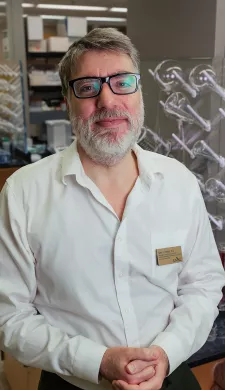
Simon Friedman is an interfacial scientist, writer and artist. He trained in chemistry at Massachusetts Institute Technology (S.B.), University of California, San Francisco (Ph.D.) and California Institute of Technology (National Institutes of Health, or NIH, postdoctoral fellowship). He is currently a Curators Distinguished Professor at the University of Missouri-Kansas City and heads an NIH supported laboratory focused on biomedical problems at the interface of chemistry and biology. His work has been described in the pages of The Economist, The New York Times and on NPR. He is the winner of Science Magazine’s “Visions of the Future” essay contest, a featured writer for Nature Chemistry’s “In Your Element” series and featured in multiple films in the New York City Food Film Festivals, including a selection as “Best of the Decade” in 2016. He has also won the University of Missouri’s highest award for teaching, the Governor’s Award. In addition to speaking internationally on his research, he has given talks on “Tradition” to the Creative Mornings Community and “The Role of Immigrants in American Science” to TEDx.4
Continuing Professional Education Credit
Successful Completion of this activity, which includes participating in the educational offering, participating in the evaluation process and completing the verification of attendance, enables the learner to satisfy the requirements for continuing education.
Nursing Contact Hours
University of Missouri Sinclair School of Nursing is approved as a provider of nursing continuing professional development by the Midwest Multistate Division, an accredited approver by the American Nurses Credentialing Center’s Commission on Accreditation (ANCC).
1.0 contact hour may be awarded.
Physicians
The University of Missouri-Columbia School of Medicine is accredited by the Accreditation Council for Continuing Medical Education (ACCME) to provide continuing medical education for physicians.
The University of Missouri-Columbia School of Medicine designates this live educational activity for a maximum of 1 AMA PRA Category 1 Credit(s)™. Physicians should only claim the credit commensurate with the extent of their participation in the activity.
Financial Relationships
Current ACCME and Midwest Multistate Division, ANCC rules state that participants in continuing education activities should be made aware of any relevant affiliation or financial interest in the previous 24 months that may affect the planning of an educational activity or a speaker’s presentation(s). Each planning committee member and speaker has been requested to complete a financial relationship reporting form for the NextGen Precision Health Discovery Series. No planning committee member or speaker has a relevant financial interest.
About the Discovery Series
The NextGen Precision Health Discovery Series provides learning opportunities for UM System faculty and staff across disciplines, the statewide community and our other partners to learn about the scope of precision health research and identify potential collaborative opportunities. The series consists of monthly lectures geared toward a broad multidisciplinary audience so all can participate and appreciate the spectrum of precision health efforts.
For questions about this event or any others in the Discovery Series, please reach out to the NextGen engagement team at nextgen@umsystem.edu.