
"The Ecology and Evolution of Learning Across Species"
Speaker: Aimee Dunlap, PhD
Professor, Department of Biology
University of Missouri-St. Louis
Director, Whitney R. Harris World Ecology Center
Date: May 12, 2026, noon-1 p.m.
Location:
The Chamber Room
UMSL Millennium Student Center
 Register Here
60-Second Preview
Description
“Cognition evolves to solve challenges in the natural environment,” says Aimee Dunlap, PhD, associate professor of biology at the University of Missouri-St. Louis. “So we can pull all of these things together and take the best of ecology and evolution, and combine that with neuroscience and theoretical modeling, to learn a little bit more about how animals – and humans – solve challenges in the world.”
Dr. Aimee Dunlap’s journey to biology wasn’t entirely traditional. She began her undergraduate studies as a history and English major, but an expanding fascination with animal behavior and the intricacies of the brain ultimately set her on the path of scientific discovery. Today, her work revolves around the ecology and evolution of information use – specifically, sensory biology, learning, memory, and decision making.
Over the course of her career, Dr. Dunlap has chased pinyon jays through the mountains of Arizona, tracked dung beetles in Finland, and modeled the behaviors of blue jays and bumblebees. Currently, her research primarily focuses on arthropods like bees, flies, and tarantulas. By observing how these species adapt to solve problems, her team works to uncover fundamental truths about cognitive evolution that relate to all animals, including humans.
“When we can figure things out in smaller animals, that helps us understand what’s happening across all of the animals,” she says. Despite having far fewer neurons than humans, bees can solve complex problems. In fact, while observing how bees “shop” for different flowers during their foraging, Dr. Dunlap’s lab finds striking similarities to human shopping from models of consumer economics.
About the Speaker
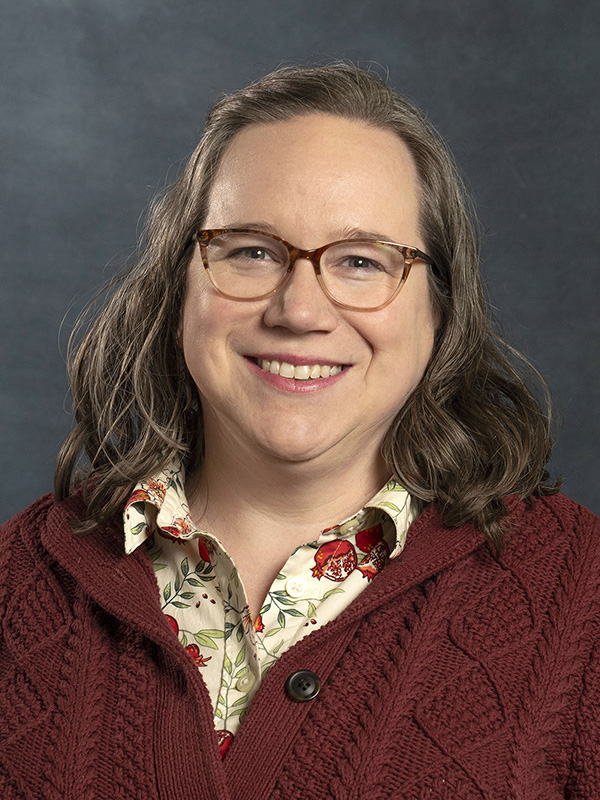
Dr. Aimee Dunlap leads a lab of scientists studying cognitive ecology within the Biology Department at the University of Missouri- Saint Louis. They are also closely affiliated with the Whitney R. Harris World Ecology Center and with the Center for Neurodynamics. The primary focus of their research is investigating the role of environmental variability in the evolution and ecological function of cognition (perception, learning, memory, and decision making). How do animals track changes in their environments? When is learning and tracking a good strategy? How should animals weight different sources of information? And how do these choices affect conservation outcomes for animals? To answer these questions, the lab uses a mix of theory and experiments, working on time scales ranging from single foraging bouts to experimental evolution studies across many generations, and with studies both in the laboratory as well as in the field. They are interested in the interplay between evolution and the genetic and molecular mechanisms of cognition, as well as a firm understanding of natural history and the problems the animals are solving in nature. They center the welfare of the animals they study, working to better understand how to best care for and work with arthropods.
About the Discovery Series
The NextGen Precision Health Discovery Series provides learning opportunities for UM System faculty and staff across disciplines, the statewide community and our other partners to learn about the scope of precision health research and identify potential collaborative opportunities. The series consists of monthly lectures geared toward a broad multidisciplinary audience so all can participate and appreciate the spectrum of precision health efforts.
For questions about this event or any others in the Discovery Series, please reach out to Mackenzie Lynch.
Reviewed 2026-04-24