
Good evening,
The goal of this email is to provide a regular source of useful information to staff and faculty of the University of Missouri System regarding the federal government and higher education. We have put together a list of news articles that will keep you informed of the actions taken by the executive, legislative, and judicial branch of government. These articles are meant to be informative and are not a reflection of the views or stance of the system regarding these issues.
If you would like more information regarding any of the stories we share, or if you have any suggestions, please feel free to contact Dusty Schnieders schniedersd@umsystem.edu and/or Emily Lucas el59bz@umsystem.edu.
Follow UM Government Relations on Twitter: @UMGovRelations
Capitol Hill News
This week Congress passed five FY26 appropriations bills covering Defense, Labor Health and Education, Transportation, Financial Services, and State and Foreign Operations. The package also includes a two-week continuing resolution for the Department of Homeland Security, enacted at the direction of Donald Trump. In addition to border security and immigration agencies, DHS funding supports the Federal Emergency Management Agency, the Coast Guard, the U.S. Secret Service, the Cybersecurity and Infrastructure Security Agency, and other critical functions. The short-term stopgap provides Congress and the White House additional time to negotiate a final DHS spending agreement.
Senate Amendment to H.R. 7148, the Consolidated Appropriations Act:
- Defense
- Labor, Health and Human Services, Education, and Related Agencies
- Transportation, Housing and Urban Development, and Related Agencies
- Financial Services and General Government
- National Security, Department of State, and Related Programs
HASC chair seeking $450B for defense in reconciliation
Breaking Defense – February 4, 2026
House Armed Services Committee Chairman Mike Rogers is pushing for an unprecedented $450 billion defense funding package through budget reconciliation to close what he sees as a major gap between the expected White House defense request and the administration’s long term national defense goals. Rogers argues traditional appropriations alone cannot meet the scale of modernization required and is positioning reconciliation as the primary vehicle to accelerate investments in missile defense, next generation air and naval platforms, and expansion of the defense industrial base. The proposal faces political headwinds due to narrow House margins and competing Republican priorities but signals an aggressive FY27 posture that elevates defense spending and industrial capacity as central to national security and strategic competition.
Republican working on new clean energy tax push
E&E News by Politico – February 5, 2026
The legislation seeks to revive incentives gutted last year in the GOP’s One Big Beautiful Bill Act. Rep. Brian Fitzpatrick (R-Pa.) is one of his party's most prominent voices on energy and environment issues, often siding with Democrats. The legislation comes as both Republicans and Democrats talk up affordability ahead of the midterm elections; electricity prices stand to be a key pillar.
Delegation News
Congressman Bell – February 3, 2026
U.S. Representatives Wesley Bell (D-Mo.), Deborah Ross (D-N.C.), Richard Hudson (R-N.C.), and Mark Messmer (R-Ind.) introduced the bipartisan Defense Technology Hubs Act of 2026, directing the Department of Defense to create a nationwide network of regional hubs focused on accelerating emerging defense technologies. These hubs would support talent development, technology transition, and collaboration among universities, defense partners, nonprofits, and local governments. By expanding innovation capacity and strengthening workforce pipelines, the bill reinforces U.S. national security and enables communities nationwide to contribute to the future of American defense.
Congressman Alford Press Release – February 5, 2026
Congressman Alford delivered $22,839,700 in Community Project Funding for Fourth District communities, including:
- $4,200,000 for safe and reliable reactor operations at the University of Missouri in Columbia
- $3,000,000 for an agriculture animal genetics facility at the University of Missouri in Columbia
Congressman Cleaver Secures More than $15 Million in MO-05 Through Appropriations Packages
Congressman Cleaver Press Release – February 5, 2026
U.S. Representative Emanuel Cleaver, II (D-MO) announced that he has secured $15,468,000 in Community Project Funding for public safety, infrastructure, and economic development initiatives across the Fifth Congressional District of Missouri as part of the 2026 appropriations packages that were recently signed into law.
Federal News
War Department’s Six Critical Technology Areas
Office of Under Secretary of War– January 29, 2026
The Office of the Under Secretary of War for Research and Engineering (OUSW(R&E)) today announced the accountable leaders selected to direct the War Department’s six Critical Technology Areas (CTAs). The six CTAs—Applied Artificial Intelligence (AAI), Biomanufacturing (BIO), Contested Logistics Technologies (LOG), Quantum and Battlefield Information Dominance (Q-BID), Scaled Directed Energy (SCADE) and Scaled Hypersonics (SHY)—are critical Department-wide imperatives designed to maintain American military dominance.
New Pentagon science-and-innovation board arrives as administration cuts research funding
Defense One – February 3, 2026
The Pentagon's new Science, Technology, and Innovation Board, a merger of the decade-old Defense Innovation Board and the 70-year-old Defense Science Board, includes defense science experts in areas such next-generation autonomy, testing, advanced hypersonics, and acquisition. It also includes private-sector experts in fields such as advanced neural networks. The new board emerges at a time when the military is keen to integrate artificial intelligence into more of what it does, reach new research breakthroughs more rapidly, and quickly produce large numbers of cheap, highly autonomous drones. The new board is the latest in a series of Pentagon moves to merge offices or activities launched over the last decade and accelerate the adoption of AI, particularly dual-use AI from companies that also sell to the public.
War Department Launches AI Acceleration Strategy to Secure American Military AI Dominance
U.S. Department of War – January 12, 2026
The Department of War launches a transformative Artificial Intelligence Acceleration Strategy that will extend our lead in military AI deployment and establish the United States as the world's undisputed AI-enabled fighting force. Mandated by President Trump, this acceleration strategy will unleash experimentation, eliminate legacy bureaucratic blockers, and integrate the bleeding edge of frontier AI capabilities across every mission area to usher in an unprecedented era of American military AI dominance.
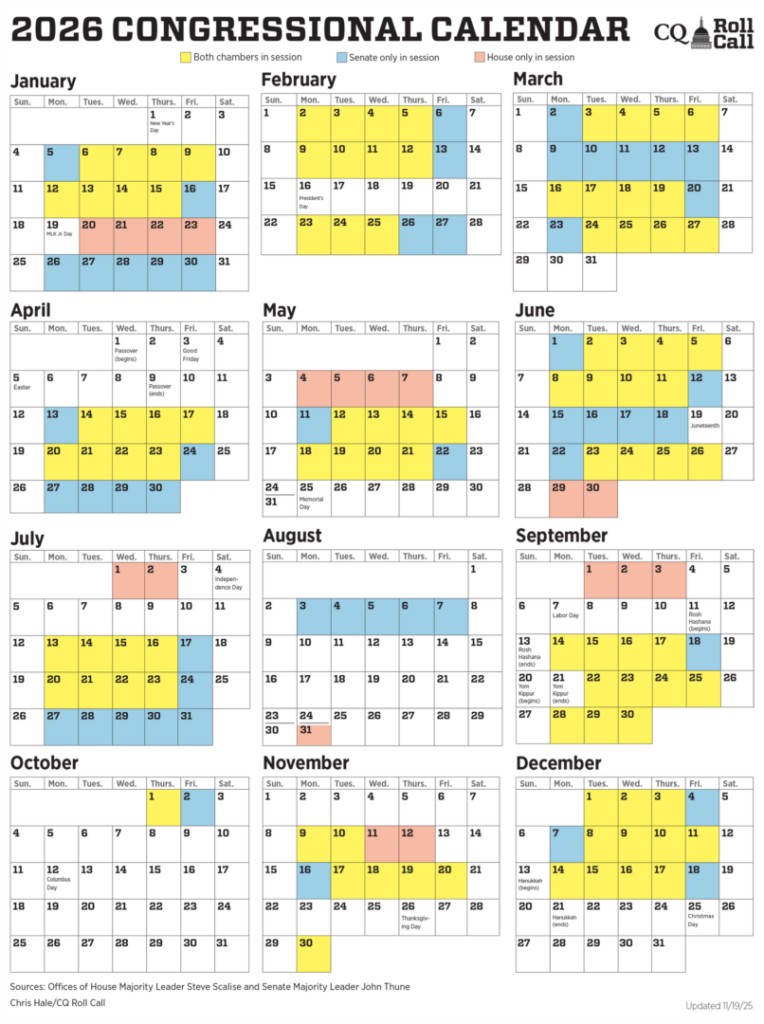
Congressional Calendar
Reviewed 2026-02-06