University of Missouri/University of Western Cape
Faculty Exchange Program
Progress Report
Perceptions of Physical Appearance in Africa: Skin Tone and How It Shapes Dating and Health of Young Adults at the University of Western Cape
Dr. Antoinette M. Landor Human Development and Family Science
University of Missouri
“Do not judge me by my successes, judge me by how many times I fell down and got back up again.”
– Nelson Mandela
I have always dreamed of conducting colorism research in Africa and the UMSAEP Program provided the perfect opportunity for me to develop and maximize international collaborations. This exchange visit represented the first step towards establishing research collaborations with faculty at the University of Western Cape (UWC). My ultimate goal is to conduct large-scale cross-national comparative studies of Black Africans and African Americans to gain a more complex and nuanced understanding of colorism and its consequences in society.
The initial project was planned for Spring 2020; however, the Covid-19 pandemic delayed the project start. After several changed dates and flights, I was finally able to travel to South Africa in March/April 2022. I was beyond excited and immediately informed the graduate and undergraduate students in my research lab of the possibility to travel with me to assist in data collection. At the time, we were conducting on-campus focus group interviews for a study with Black University of Missouri (MU) students so I knew that students from my lab would be an asset for me in South Africa.
Thanks to financial support from MU’s Henry Mitchell Scholarship with additional support from my research account, four students from my research lab, including three doctoral students (Jasmine Godwin, Jessica Marmolejos, Joelle Smith) and one undergraduate McNair Scholar (Aminah Bradley-Pikes) accompanied me on this trip. For most of them, this was their first international trip, and they were ecstatic about this once-in-a-lifetime opportunity. During their time in South Africa, students gained first-hand research experience recruiting study participants despite cultural barriers, conducting focus group interviews, and taking field notes.
Dr. Antoinette M. Landor
From the first focus group interview, I knew that this project would be very successful. Study participants were incredibly thoughtful, forthcoming, and candid about their experiences with skin tone and colorism in South Africa. The data are very insightful and rich in descriptions. In fact, participants had so much to share that I had to eliminate several focus group questions and stop focus group discussions given study time limits. If not, the participants would have talked to us for hours. Many of the students wanted to continue the conversation after their focus groups and even reached out to me to look for potential opportunity to continue the colorism discussion. Moreover, I eventually turned away many other students who wanted to participate in the study because I had reached study data collection goals.

*Dr. Landor and her Research Team
Brief Background and Research Study Aims
Colorism, defined as the unequal treatment and discrimination of individuals based on the lightness or darkness of their skin tone (Landor & McNeil Smith, 2019), has played a historically influential role in the lives of individuals across the world. Colonial rule in the African continent fostered an implicit belief in whiteness as a source of unique privileges. Thus, over time, beliefs in light skin privilege were internalized and deeply embedded into Africans’ cultural and ideological routines. Given this reality of colorism in Africa, cultural beauty norms around skin tone have been linked to widespread use of skin lightening products and racialized cosmetic surgeries. However, the vast majority of skin tone research has primarily focused on U.S. populations and the body of literature exploring colorism outside of the U.S., particularly in sub-Saharan Africa, is limited. There is much to learn about the perceptions and implications of skin tone and colorism outside the Western world. To this end, this project focused attention on colorism in South Africa.
Focus Group Details and Data Analysis
The study was approved by MU’s Institutional Review Board (IRB) and UWC’s Research Ethics committees. Several on-campus, in-person focus group interviews were conducted with a total sample of 74 Black African/native and/or coloured college-aged young adults at UWC. Each focus group discussion lasted approximately 90 minutes. Participants spoke English but I encouraged them to speak other languages such as Xhosa, Afrikaans, and/or Zulu, if needed, in order to better understand the dialect used to describe messages around skin tone and colorism. All focus group interviews were audio-recorded, and research team members wrote field notes during each focus group discussion.


*The study flyer, photos of Black African and U.S. Celebrities with varying skin tones (I showed each focus group these photos to further explain differences in skin tone), and pictures from the study.
Data Analysis
Focus group interviews were initially transcribed using the transcription feature in Zoom. Participants and research team members wore masks given Covid-19 protocols. However, due to mask wearing, background sounds, and accents, the Zoom transcription feature did not work as anticipated. As a result, creating accurate transcripts took significantly longer than planned. Research team members worked on transcribing each session verbatim throughout the summer. This task was completed at the end of the summer, and we are conducting a final review of all transcripts. This delay has greatly impacted my timeline for data analysis, but I am excited about the richness of the data and the papers that will be published as a result of these invaluable conversations.
Preliminary Project Findings
Building on my previous research (Landor & McNeil Smith, 2019; Landor & Barr, 2018), participants vividly detailed their experiences of colorism and skin tone trauma. As a researcher who has been studying colorism for over a decade, this project reminded me of the continued value of hearing the voices of participants to help illuminate how skin tone and colorism is experienced in South Africa.
Below are a few candid quotes from study participants when asked about their perceptions of skin tone and colorism in South Africa.
Ms. X stated “You experience it every single day, you experience it growing up. It’s in our media, it’s in our daily lives. You grow up as a young Black woman, knowing, and just knowing, like, a lighter, a lighter-skinned person than you, even if you’re both close, or even if you’re both, like, Black, the lighter-skinned woman than you is perceived as better. Dark skin women in South Africa have to prove themselves. To a point that you are always perceived as angry, you are always perceived as less intelligent, less of everything. And you always have to stick up for yourself, every space we walk into. Because we are always undermined as soon as we walk in, compared to other lighter-skinned or fair skinned [women].”
In discussing experiences of colorism in local shops, focus group participant Banana said “But it’s kind of different when you are around people that are completely different colors, meaning they are lighter-skinned, because you do see that they are treated completely differently. Um, they get better service, at different places compared to you. Like, literally, you can see a lighter person standing in front of you in the line and getting much better service, actually being greeted, and being asked extra questions… and you get there and it’s always like they just look at you like, “Okay, tell me why you're here”— that type of thing.”
Upcoming Scholarly Products
The first paper from this project, titled Colorism across the African diaspora: Examining skin tone trauma among Black young adults in the U.S. and South Africa, will be featured as part of an upcoming journal Special Issue on Colorism. The manuscript proposal was accepted in August 2022. Furthermore,
various research team members and I are taking the lead on additional papers for publication this semester and in the Spring. I am already planning to disseminate results at upcoming national conferences such as the Society for Research on Adolescents (SRA) in San Diego, CA next year. While in South Africa, I was also the Keynote Speaker at a conference in the U.S. (via Zoom). My keynote address was on Colorism, and I was excited to be able to discuss the South African colorism project.
Future Plans
In addition to publishing study results in high-impact journals, and presenting this work at national and international conferences, study findings will also serve as pilot data for external national and international grants (e.g., Fulbright, National Institutes of Health, National Science Foundation). Lastly, I am an invited speaker for the national Dove® Self-Esteem Project’s “Action Tank” Event in Washington,
D.C. this September as an Expert on Colorism. The event is titled Dismantling Harmful Beauty Ideals: An Action Tank to Address a Silent Public Health Crisis. I am eager to talk about the results of this South African colorism project.
Engagement Activities
During my time in Cape Town, I had the opportunity to meet with Umesh Bawa, Director of International Relations at UWC. He graciously showed me around Cape Town and I really enjoyed getting to know more about his research, UWC, the city of Cape Town, and South Africa, more broadly.
Towards the end of my trip, I was also introduced to Trevor McArthur, Lecturer in the Department of Sociology at UWC. Given our similar research interests, we had engaging conversations about research and established a new collaboration. His hospitality was critical to my overall experience in South Africa. In addition to conducting my research project, I was also really interested in understanding South African culture as well as visiting some of the South African townships that research participants talked about during focus group interviews. Trevor (and his family) not only welcomed me in their home, but they also gave me a guided tour of Cape Town providing important historical facts about Apartheid and its present-day consequences. I had the opportunity to see Khayelitsha, the largest township in Cape Town, and other townships. I was thrilled to be immersed in all the sights, sounds, and smells. What I observed in Khayelitsha was beyond inspiring! Despite being one of the poorest areas of Cape Town, the joy that radiated from all over this lively township was contagious. Children played soccer in a large field while enjoying the sun and the competition, community members walked around laughing and loving on one another— it was beautiful to see. We even ate at a local restaurant while listen to music and watching community members laugh, dance, and enjoy the day. I realized immediately that this vibrant and jubilant atmosphere was just like being in many Black neighborhoods in America— and I felt right at home.
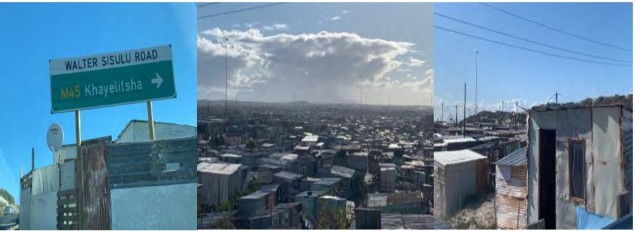

I also gave a lecture to students and faculty at UWC. The presentation was well received and created interesting discussions afterwards.
Personal Reflections: Experiencing the Sights and Sounds of Cape Town
After I received notification that my South Africa project was going to be funded, in part, by UMSEAP, I immediately took a DNA test to get a sense of “my roots” (my genetic roots, that is). I was born in southern Louisiana and most of my family history is difficult to locate given inaccessible local records and incomplete record keeping as a result of slavery. At this point, without help from Dr. Henry Louis Gates at Harvard University and his groundbreaking show Finding Your Roots on PBS, acquiring my DNA results from a popular genetic testing company was the next best thing. Right before I was initially scheduled to travel to South Africa, I received my DNA test results which revealed a significant proportion of my lineage was from Nigerian, Sierra Leone, and Ghana. I was ecstatic about this news and immediately told everyone. I was so proud to see the direct genetic connection to Africa and it made me even more motivated to travel there!
I love international travel given the limitless experiences of new cultures and meeting new people. I have traveled across the globe to Australia, the Bahamas, Canada, Cuba, the Dominican Republic, France, Greece, Holland, Italy, Mexico, Scotland, Spain, Thailand, United Kingdom, New Zealand, just to name a few, but surprisingly I realized that I had never been to the continent of Africa. Unlike any other place I have traveled, as an African American, arriving in Africa was like “coming home.” It was my personal “Wakanda Forever” moment (a salute to every one of the African Diaspora and a tribute to Black excellence around the world)! This is the continent where my ancestors resided. As soon as I stepped off the airplane in Cape Town, I could already feel an overwhelming sense of commonality and connection. Throughout my time in Cape Town, it wasn’t the deep conversations but the simple interactions with Black South Africans that made me feel genuinely welcomed. In fact, one of these memorable moments occurred while perusing shops on Long Street. We went into a souvenir shop and when the Black African owner heard me speak, he immediately said “Welcome Home Sisi” (which means “Sister” in the Xhosa language). I became very emotional and at that moment felt that despite the “social distance” between African Americans and Black Africans… we are indeed family.
Cape Town is a stunning city and its beauty is breathtaking. I underestimated the natural wonders including picturesque and iconic Table Mountain and towns surrounding the mountain. I was able to see all parts of Cape Town and share many experiences with my research team as we took tours through the countryside. We visited gorgeous wine vineyards, powdery sand beaches, and rugged landscapes, and was immersed in the dynamic South African culture. We ate at a local authentic African restaurant called Fatima’s and spent one evening at a popular restaurant called GOLD, which featured a 14-dish African feast with live African entertainment including traditional storytelling, singing, dancing, and face painting.
Below are pictures of the wineries of Stellenboasch, among others, and the coastline beaches from Camps Bay to Llandudono. We took scenic drives exploring spectacular views along the rocky coastline of Cape Peninsula, including stops at Boulders Beach to see the African Penguins, Simon’s Town and the scenic coastal towns of Fish Hoek and Muizenberg, and the renowned Cape of Good Hope. I also experienced the vibrant and colorful neighborhood of Bo-Kaap as well as Greenmarket Square in downtown Cape Town. I learned that South Africa is three times larger than the state of Texas and that Cape Town is South Africa’s oldest city and legislative capital and known as the “Mother City.” I even experienced load shedding (up to Stage 3/4 for two weeks)!
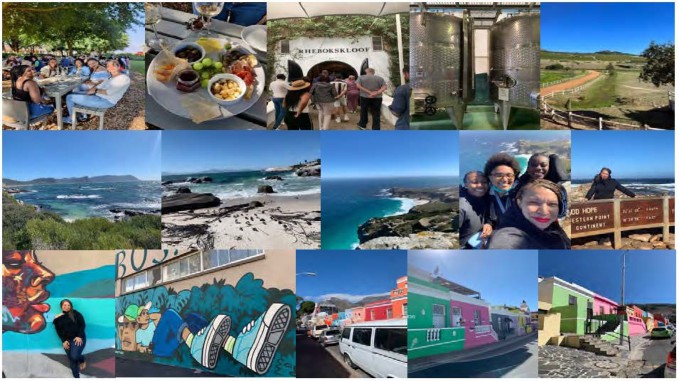
Amid all this beauty and wealth, however, I was acutely aware of South Africa’s tumultuous history. I saw historical and contemporary signs of colonialism all around me no matter where I traveled throughout Cape Town. For instance, seeing tour guides and other employees wearing name tags with English names. I asked several people about this, and they said that they changed their names to make it easier for tourists to pronounce. Though understandable from one perspective, from another viewpoint it seems like an erasure of one’s identity and culture. I pondered… is it necessary to make names “easier for tourists”? I witnessed countless examples of the present-day consequences of colonialism and Apartheid— including in the colorism conversations that were part of my research project.
In sum, this experience in South Africa— both professional and personally— has made an impactful and lasting impression on me. I think that South Africa is one of the most beautiful and fascinating countries in the world!
Special Thanks
I am extremely grateful to Dr. Rod Uphoff and the UMSAEP Program committee for providing this amazing opportunity to visit South Africa and conduct important research on colorism. In addition, with critical funds from the Henry Mitchell Scholarship and a funding match from my research account, students from my research lab where able to accompany me on the trip. Rod was outstanding in facilitating all travel arrangements for myself and my research lab members and he provided very useful travel tips. This helped to alleviate the stress that comes with searching for lodging and flights for a place that you know little about. And a special thanks to my research team for our invaluable discussions and for helping to pivot when research objectives did not go as planned. Despite a few bumps in the process, this trip and the data collection was an overwhelming success. Yet, there is still so much more to explore and learn in South Africa!
We came. We saw. We accomplished a great deal. We also left with incredible gratitude for all of the Black and Coloured South Africans in the research study. Farewell Cape Town and I look forward to seeing you again!
Reviewed 2025-12-22