UMSAEP UM-UWC Linkage Program Report
Prof Ashwil Klein
Department of Biotechnology
Plant Omics Laboratory & Proteomics Unit
Hosted by:
Prof Walter Gassmann
Director of the Bond Life Science Center University of Missouri, Columbia Campus
Visit date: 16 September – 9 December 2021
Overview
The research exchange visit to the University of Missouri (Columbia) represented the first steps towards establishing a mutually beneficial research collaboration between the plant omics driven research focus of Plant Omics Laboratory (UWC) and molecular biology & plant pathology expertise offered by the Gassmann laboratory (Columbia, Missouri). I was hosted by Prof Walter Gassman in the Bond Life Science Centre at MU for the duration of my visit. I was fortunate to be accompanied by my PhD student (Mihlali Badiwe) who gained international exposure and experience in molecular pathology under the mentorship of Prof Gassmann and Dr Leland Cseke.
In addition to promoting collaborative initiatives between the Plant Omics Laboratory (UWC), and that of Prof Walter Gassmann (MU-Division of Plant Sciences) this visit also seek to strengthen the existing links between plant scientists at MU and UWC. This was my third visit this beautiful campus and gave me the opportunity to catch up with colleagues/friends in the interdisciplinary Plant Group (IPG).
Visit activities
The activities linked to the visit include receiving training on molecular plant-microbe interaction techniques routinely used for lettuce in the Gassmann Lab. We also worked on a project that seeked to identify and molecular characterization bacterial pathogens isolated from wild lettuce (US) that can pose a threat to lettuce cultivation in Missouri and possibly South Africa. The training provided by the Gassmann lab is critical for research at UWC and will facilitate skills transfer between MU and UWC (expertise in phytopathology at UWC is in its infancy). Based on the work done by the Gassmann lab on the plant innate immune system of the model plant Arabidopsis, they identified lettuce as an ideal system to answer some basic questions beyond what was learnt from Arabidopsis. This will provide an excellent platform to establish a lettuce-bacterial pathogen system.
Objectives achieved
-
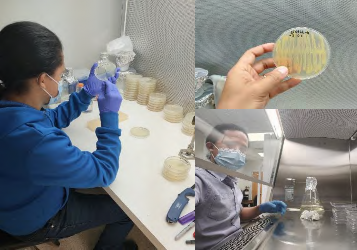
Isolation and sub-culture of bacterial pathogens
Bacterial strains from diseased/infected lettuce cultivars were isolated and sub-cultured on nutrient agar plates. Liquid cultures were prepared from single distinct bacterial colonies by inoculation in LB broth.
-
DNA isolation and sequencing
High molecular weight genomic DNA was isolated from 48-hour old bacterial colonies using standard DNA extraction methods. Genomic DNA was visualized on a 1% agarose gel and quantified using the NanoDrop ND®-1000 spectrophotometer. The 16S rRNA gene from the bacterial genomic DNA was amplified by Polymerase Chain Reaction (PCR) using bacteria universal primers (27 and 1492R). PCR products and genomic DNA was sequenced at the DNA Core facility (MU). The gene sequences obtained was compared by alignment against no-redundant sequences in GenBank using the Basic Local Alignment Search Tool (BLAST) search program at the National Centre for Biotech Information (NCBI).

-
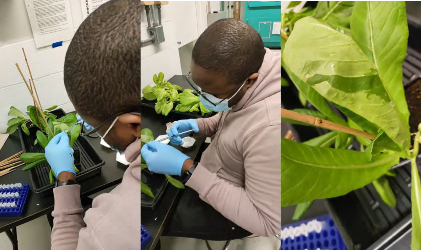
Infiltration of lettuce cultivars with bacterial pathogens
Bacterial pathogens (of interest) isolated and characterized from wild lettuce was used to re-infiltrated a subset of lettuce cultivars representing seven lettuce types including butterhead, crisphead, latin, leaf, stem, romaine and oilseeds. Based on the disease index, we intent to build a lettuce-pathogen interaction matrix as we expect to identify different bacterial pathogens species for some lettuce cultivars. This matrix will provide fundamental basis for scientist to develop cultivars resistant to multiple potential bacterial pathogens.
-
Nationwide survey of bacterial pathogens of wild lettuce
This objectives was adjusted and instead of surveying the bacterial pathogens nationwide we only collected and characterised lettuce bacterial pathogens in the Columbia-Missouri. The future plan is to expand the survey to include more bacterial pathogen across a larger geographical region in the US.

Outcomes of the research visit
-
We have successfully completed all the objectivise listed for this visit
-
The data generated from this study will be drafted into a manuscript
-
In addition to the proposed objectives we also contributed to other projects that was running in the laboratory
-
Myself and Mihlali presented our research to the members of the Gassmann laboratory and received excellent feedback
-
Based on the fruitful discussion I had during my visit I am finalizing a grant application for research funding towards our collaborative project and to send another student to the laboratory of Prof Gassmann
-
Acknowledgements
I would like to express my sincere gratitude to the committee members from the University of Missouri and the University of the Western Cape for the opportunity and financial support to visit the laboratory of Prof Gassmann at MU (Columbia campus). Although my initial travel plans were delayed due in 2020 to the Covid-19 pandemic I was able to travel in September 2021. I wish to thank Prof Rod Uphoff and his team, Ms Debra Lamson and her team at UWC for facilitating all travel arrangements to the US and back home without a glitch. A heartfelt thank you my host Prof Walter Gassman and his wife (Ali) for their friendship, hospitality, support, great dinners and excellent discussions. I am forever thankful to them for opening their home to me for the first two weeks on my arrival. I will never forget that level of hospitality you showed towards me. Thank you to the Gassmann Lab members (Jianbin, Katie, Sanzida) especially Dr Leland Cseke who welcomed us and showed patience when we were still finding our feet in the lab. I also wish to thank the members of the IPG (Prof David Mendoza-Cozatl, Dr Norma Castro, Prof Scott Peck, Prof Bob Sharp, Prof David Braun, Prof Paula McSteen) for their friendship, valuable discussions and advice.
Reviewed 2025-12-22