UMSAEP Report Denise Mussman
I was fortunate to be awarded a grant to work with a faculty member at the University of the Western Cape (UWC), Dr. Venicia McGhie. The objective of the collaboration was to create an academic English as a second language intervention project for a group of freshmen students in the business college at UWC and in so doing, strengthen the students’ English language proficiency and increase retention of the students. The goals of this two-week program, named the English Language Support Course, were to:
- Offer classes of academic support in vocabulary, listening, reading, and test preparation to strengthen the language proficiency in English;
- Measure the effectiveness of the support provided;
- Determine which lessons are most effective in building and enhancing the students’ English language development, which will assist curriculum at UMSL; and
- Increase communication and collaboration between UMSL and UWC faculty.
The participants were new first-year students in the foundation program registered in the EMS Faculty at UWC. African and Coloured (mixed race) second language speaking students of English volunteered to join the two-week course during the 2019 winter break at UWC. The course included lessons on English grammar to assist writing skills, vocabulary strategies to improve reading comprehension, and small group discussions and oral presentations to enhance speaking skills.
Dr. McGhie, in the Department of Academic Development, Faculty of Economic and Management Sciences at UWC, organized the program. She sent an invitation to all the first-year students in the business faculty. Senior students and those from other faculties heard about the invitation and asked if they could also attend the course; fourteen were able to arrive. Funding was provided by the Deputy Provost Academic Affairs at the UWC for food and board for the students, most of whom preferred to stay on campus due to transportation costs. During the winter vacation, the students had no financial aid and thus, no means for public transportation to classes. The program was a two-week block, July 1- July 11, from Monday to Thursday, and the schedule was from 10:00 am until 4:00 pm, with breaks for coffee and lunch. There were four and half hours of instruction each day, for a total of eight days.
The program was a success due to several major factors. A primary one was the smaller class size of 14 students, which was conducive to an informal learning environment that made students feel comfortable expressing themselves in English; the instructor was able to quickly learn the students’ names, call on individuals to answer questions or share perspectives, and add humor to the lessons. Frequent pair and group discussions were a highly effective means for the students to learn from each other and increase their levels of self-efficacy in using their academic English, in speaking English; in addition, students commented on enjoying learning the perspectives of others and more so, being able to express themselves and find their “voice.” This was an intense source of empowerment and built confidence in their identity as scholars and speakers of English.
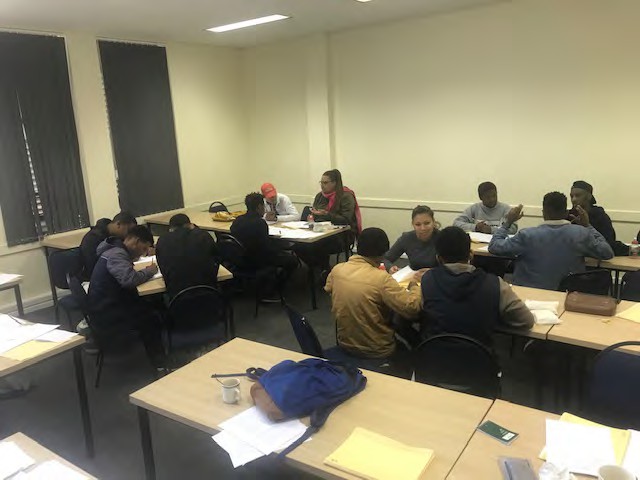
Below is a picture of the students working in groups:
In addition, the curriculum was effective in helping the students build academic skills in English and their levels of confidence. It included strategies to increase English vocabulary, grammar and word forms; writing assignments; readings; study strategies; and three individual presentations. Data were collected at the beginning, middle, and end of the program to assess needs, improvements, and student perception of the effectiveness of the lessons and impact on their confidence.
Findings showed that the students found the explicit learning of rules of writing and grammar to be empowering. Levels of self-efficacy were improved due to the lessons,
opportunities to improve oral and presentation skills, and an interactive, relaxed environment conducive to learning. The students all orally reported in class that the lessons improved their confidence, having better understood English grammar and mechanics and how to correct their errors. Another helpful factor was the instructor and observing coordinator often emphasized to the students that effort and persistence in learning were important. The students were told not to avoid mistakes in their writing; instead, they should strive to use new words and expressions, and complex sentences.
Feedback from the students was overwhelmingly positive. One student claimed:
The classes will definitely help me academically because I’m able [to] understand much better and faster…I will only persevere and receive excellent grades because knowing what to do and how to do it is much easier than before I attended the classes.
Academically, I feel like I will be really successful in completing my degree and [it will] be a real good success story.
One student added the course will help during the next semester, stating: The English support class has improved my confidence, pronunciation, grammar and vocabulary a lot. I can apply these skills in my modules.
Nearly all of the students commented on improved confidence in their scholarly abilities. Many mentioned further abilities to express their opinions, which improves a sense of identity. A shy female student wrote: This course has assisted me personally because I defined who I am, the type of person I am, and what my dreams are. It also helped me being more confident.
Last semester I struggled a lot and I’m glad that now I’ve acknowledge [sic] my mistake…This course is the best thing ever happened to me because when I came, I hoped for change and my hop [sic] were fulfilled.
Another student said he felt he could better learn information for his future classes. He explained:
The classes will definitely help me academically because I’m able [to] understand much better and faster…I will only persevere and receive excellent grades because knowing what to do and how to do it is much easier than before I attended the classes.
Academically, I feel like I will be really successful in completing my degree and [it will] be a real good success story.
The course was a success; all the objectives were met. During the second week of the class, it was featured on the UWC website and two local newspapers. Furthermore, Dr. McGhie and I co-authored a chapter about the course in Beyond Language Learning Instruction: Transformative Supports for Emergent Bilinguals and Educators, published in November 2019. This professional publication focuses on ways educators can support students whose first language or dialect is not the language of instruction. The title of our chapter is Increasing Retention Of Linguistically-Disadvantaged Students in South Africa.
Going forward, Dr. McGhie will track the students’ progress at the end of the subsequent semester to compare their coursework grades with those of a control group. Upon analyzing the data, we will also write an article for publication in a peer-reviewed journal. Finally, we will develop the course into an online course for all the UWC students could take and practice on alongside their other courses.
We hope that the course will increase retention of the participants. Improving academic English skills and self-efficacy will help UWC reach its goals to increase retention of at-risk students, and to increase equity of student populations who are struggle with academic English language skills and self-efficacy.
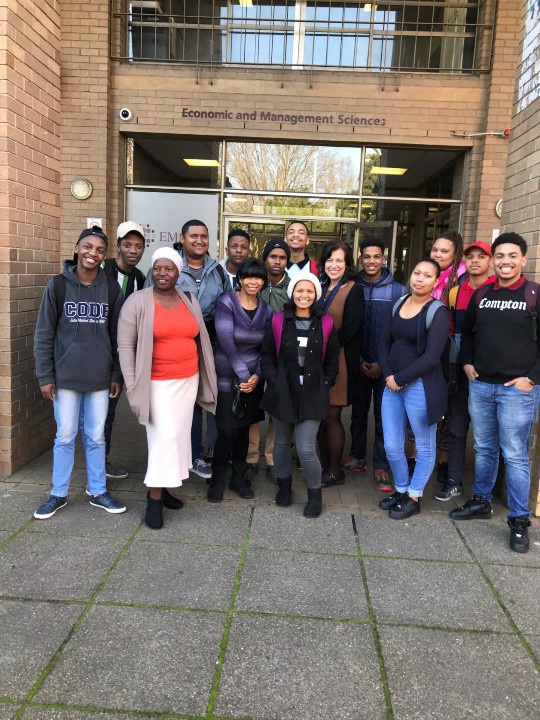
The students, coordinator Dr. Venicia McGhie, and Dr. Denise Mussman of the English Language Support Course, July, 2019.
Reviewed 2026-01-05