Dr. Natasha Ross Chemistry Department UWC
UMKC Host: Zhonghua Peng, Ph.D, Curator’s Distinguished Professor of Chemistry, University of Missouri-Kansas City Kansas City, MO64110, 816-235-2288 (pengz@umkc.edu)
Objectives achieved during 5-week visit:
-
Solar cell device fabrication
-
Synthesis of high efficiency perovskite material (required chemicals was procured) Study new approaches to methodology design
-
Prepared and submitted proposal for Sasol-NRF collaborative research grant for 2022 based on enhancing electrode materials: Title: Progressive Perovskites: A Game-Changer for South-Africa’s Solar Technology
-
Drafting review manuscript based on the development of most efficient and cost-effective solar cell devices.
Overview:
I am Senior Lecturer and Early-career Researcher at the Department of Chemistry, working within the SensorLab where I am involved in postgraduate mentoring, sensors development along with energy materials research for energy storage capacity enhancement in Lithium-ion batteries (LIB) and conversion efficiencies of Perovskite Solar cells. I am truly grateful to have been a recipient of the UMSAEP for research exchange at University of Kansas City. This was my second visit to the United States and the experience was beneficial towards my research development and building a strong collaborative partnership.
With the growing demand for sustainable energy and the current power outages causing havoc on a grand scale, reliable and cost-effective alternative energy sources are much needed! Solar power is an alternative and renewable energy source that needs no real introduction to the marketplace. Perovskite solar cells (PSCs) hold an advantage over traditional silicon solar cells in terms of its costs and simplicity of processing. PSCs like methylammonium lead iodide (CH3NH3PbI3) and formamidinium lead iodide (HC(NH2)2PbI3) show superb opto-electronic properties. However, PCSs suffer stability issues; factors that are currently impeding their commercialization. The stability can be improved by developing optimized perovskite materials and hole transporting materials.
The UM provided a wealth of resources, expert insights and a conducive environment for learning and productivity. I am most grateful for the time I had to be fully engaged with hands-on research activities and study different approaches and “tricks” in fabricating solar cell devices especially. Working with Prof. Peng gave me new insight in functionalizing novel materials with record-breaking efficiencies. I am currently applying this knowledge here at UWC to improve the methodology towards developing solar cell device with improved performance effiencies.
The research exchange visit focused mainly on synthesis, device fabrication and discussing novel approaches to design effective and highly effective perovskite materials to optimize solar cells efficiencies. We applied for the Sasol-NRF collaborative research grant, which, if approved, with allow for student exchange and the continuation of the collaborative research between SensorLab and the Chemistry department of UM Kansas City. Future work involves developing a more critical approach to the role of structure, nanostructured interfaces, and solar cell characterization processes.
The (Sasol/NRF) project will be focused on the design and synthesize organic semiconductor materials with intrinsically high charge mobility, and to produce perovskite solar cells with superior properties suitable for commercialization in the South-African landscape. The
technological possibility for massive industrial production with minimal required investment on infrastructure of perovskite solar cells makes the proposed research extremely appealing.
Deliverables:
-
Collaborative research: Prof. Zhonghua Peng, Ph. D Curators’ (UMKC) has been instrumental in facilitating new initiatives for Perovskite solar cells which will benefit Energy Research, Teaching and Training University of the Western Cape. Prof. Peng agreed to co-supervise and host both a MSc and PhD student to conduct part of research work at University of Missouri during a 6-to-12-month research visit.
-
The students and researchers: We identified areas of opportunity for a prospective MSc. and PhD. students to be trained on cut-edge research tools and methodologies. It will also improve the international research profiles of both universities as well as the relationships between both countries. The teaching and training programmes at the UWC and UM will also benefit from capacitation in Solar Energy Conversion via Photocatalytic Processes.
-
Socio-economic benefits: The outcome of research and envisioned work with commercial partners will lead to lower environmental impacts over time.
-
Small energy users: such as rural households, schools, and impoverished communities. These devices are designed to provide enough energy to light a few LEDs, charge a cell phone, and provide energy for communication or early warning systems.
-
The economy: The possibility exists for producing small-scale units for niche energy requirements at a local community level. Such units could, be produced to generate enough energy to supply lighting for a rural household. It is believed that this extensively modified device and low-cost architecture will compellingly lead to the timely commercialization of perovskite solar cells.
I am happy report that I have achieved many goals while in UM. We submitted a research grant proposals (still waiting on outcome), successfully submitted 2 review articles, of which one was published on 30 Nov (https://doi.org/10.3390/app112311324) and I am in the process of submitting a review manuscript for publication (motivated by work conducted at UMKC).
I am immensely grateful to my family for their support, the University of the Western Cape for giving me this opportunity and approving my special leave request, the partner institution: University of Kansas City and my host, Prof Peng for his insights and inspiration and a special thanks to the UMSAEP director, Prof. Uphoff as well as Prof Arif Ahmed and Mrs. Debra Lamson for the much-needed support during my stay in Kansas City. The renewed insight gained through international research exchange has been invaluable and I would highly recommend the program to all emerging UWC researchers.
Outcome of prepared devices:
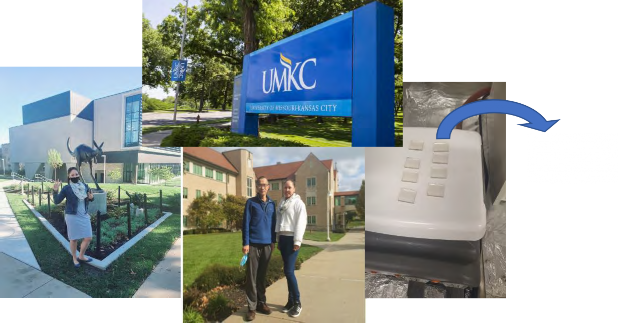
Out of the 9 devices coated with FAPbI3, four looked ok by eyes. However, when examined through the microscope, all these FAPbI3 films showed ununiformly distributed small cracks/thin lines/pinholes over the surface. And the films changed color gradually from black to yellow even stored in vacuum. It appears that additives are required to promote the stability of FAPbI3. It was reported that one of the most effective methods to achieve high-performance perovskite solar cells has been to include additives that serve as dopants, crystallization agents, or passivate defect sites.
Assessment and future work:
It was reported that pure FAPbI3-based perovskite suffers from the phase degradation from photoactive “black phase” (α-FAPbI3) to photoinactive “yellow phase” (δ-phase) with a bandgap of 2.43 eV. This spontaneous phase transition hinders the photovoltaic performance and long-term stability in humid environments. (https://doi.org/10.1002/adfm.202002964) _
The FAPbI3 solution will be made without MACl - It was reported that MACl can successfully induce an intermediate to the pure FAPbI3 α-phase without annealing. The formation energy is related to the amount of incorporated MACl. By tuning the incorporation of MACl, the perovskite film quality can be significantly improved, exhibiting a 6× increase in grain size, a 3× increase in phase crystallinity, and a 4.3× increase in photoluminescence lifetime. (Methylammonium Chloride Induces Intermediate Phase Stabilization for Efficient Perovskite Solar Cells, Joule, Volume 3, Issue 9, 2019, Pages 2179-2192, https://doi.org/10.1016/j.joule.2019.06.014<.
The activities which were not achieved at this time but will be studied in future:
-
To prepare and identify the proper morphology of Ag- decorated TiO2 with the desired optical and electrical properties based on the experimental data, then interpret the results and connect them to the reported theoretical studies.
-
Investigate the best way (s) to homogenously convert the prepared nanopowder into homogeneous continuous films without any cracks or stability issues to form the photoactive electrodes.
-
Evaluating the efficiency of the various types of modified HTM (hole transporting) nanomaterials and films on the efficiency upon their utilization in photo-electrochemical system and testing the optimized electrode assemblies as real photovoltaic.
-
A summary of future collaborative work to be conducted as part of MSc/PhD research project (2022/2023):
-
To develop a computational model to predict the solid-state order and charge carrier mobility of (HTL) DAT derivatives with a variety of substituents and to provide insight into the mode of formate intervention in Perovskite.
-
To synthesize new DAT derivatives and Pseudo-halide anion engineering for α-FAPbI3 perovskites which are computationally predicted to exhibit high charge mobility and power conversion efficiencies.
-
To characterize the new HTL derivatives and α-FAPbI3 perovskites device combinations and investigate their morphologies, optical, electrochemical, and thermal properties.
-
To measure the charge carrier mobility by fabricating hole- or electron-only devices of the solution-processed thin films before and after thermal annealing.
-
To evaluate the device efficiency and stability of perovskite solar cells (PSCs) fabricated using the solution-processed HTL derivatives and α-FAPbI3 perovskites thin film.
Thank you!
Devices prepared
Reviewed 2026-03-26