TO: Professor Ronald Uphoff, Ms. Hilda Wilson, and Dean Vuyokazi Nomlomo FROM: Professor Omiunota N. Ukpokodu
RE: UMSAEP Grant Award Project Report
DATE: May 10, 2020
I am pleased to provide a report of my UMSAEP grant award trip and project. My UMSAEP grant award to the University of Western Cape (UWC) took place from February 19 to March 9, 2020. Below I detail my experiences, encounters, interactions, and project accomplishments.
Encounters and Interactions
During my visit to UWC, I had the privilege to meet and interact with several faculty and staff that contributed to my experiences and the accomplishment of my UMSAEP project goals. These are:
- Professor Vuyokazi Nomlomo, Dean of the Faculty of Education, was my host. Dean Nomlomo and I had previously met in 2007 during my Fulbright-Hays Scholar Abroad Program to South Africa and UWC. My UMSAEP visit to UWC allowed me to engage with more deeply and deepened our relationship and conversations about our shared interests related to multiculturalism and educational transformation. She was extremely supportive and actively engaged with my visit from start to finish. We discussed important transformational initiatives, including empowering school culture, curriculum transformation, research, and publication possibilities. We have already collaborated on a joint proposal submission for a conference presentation to be held in Washington DC, December 2020. I find Dean Nomlomo’s down-to-earth personality and openness to transformational change refreshing and synergistic. I am excited to be collaborating with her.
- Professor Trevor Moodley (Chair, Department of Educational Psychology) was my primary collaborator and point-person who planned and attended to my day-to-day activities and meetings. My interactions with Professor. Moodley began prior to my arrival at UWC. We had email exchanges as I completed the Humanities and Social Science Research Ethics (HSSRE) application. My interactions with Professor Moodley were substantive and intellectually stimulating as we conversed about many topics of common interests that ranged from South African education, teacher education, politics, culture, and history to multicultural issues—race, gender, class/poverty, language, immigration—and other systemic issues in post-apartheid South Africa. These conversations were extremely valuable to my project. I was in awe of his brilliance and passion for these issues. He helped me gain access to needed curricular materials for my project. He introduced me to faculty and staff, within and outside the Faculty of Education, garnered support for my project, and facilitated meetings and interactions with them. Professor Moodley also arranged for me to make a presentation to the faculty, which increased my visibility within the Faculty of Education and across campus. Professor. Moodley and I are collaborating on some research, conference presentation, and curriculum initiatives on multiculturalism. We have collaborated on a joint proposal submission for a conference presentation to be held in Washington DC, December 2020. Other possible collaboration includes article and book publications. I am excited about our collaboration. I deeply appreciate the respectful and productive relationship we have built.
- Mr. Frederick Sylvester (Lecturer, Department of Educational Psychology). My interaction with Mr. Sylvester was, and has been tremendously valuable. Upon my arrival on campus, he warmly received me and invited me to visit his class where I observed his interactions with his students. We had extensive and substantive discussions about his work and our common interests in transformative praxis and social activism. Mr. Sylvester provided me with one of the highlights of my visit, when he took me and another US visiting scholar, on an all-day tour of Cape Town that was sponsored by Dean Nomlomo. The tour was extraordinary rich, breath-taking, and memorable. Despite his busy schedule, Mr. Sylvester took me on a second tour of Cape Town and the township of Langa. The Langa township tour was incredible, and increased my knowledge about the community—historical sites, schools, cultural centers, etc. Through these tours and conversations with him, I became in awe of the breath, and depth of Mr. Sylvester’s wealth of knowledge, his prolonged activism within the community, and his transformative praxis. Our philosophical views and teaching interests intersect in ways that have helped us map out some collaborative research projects, including the short-term study abroad program I aimed to explore during my visit. His wealth of experience and familiarity with the communities, especially the schools, will be invaluable to the program. We have established regular email exchanges since my return to the US. I am looking forward to our collaboration.
- Ms. Nonhlanhla Shandu-Omukunyi (Lecturer, Department of Language Education): I was privileged to meet Ms. Nonhlanhla Shandu-Omukunyi. I had multiple opportunities to meet and engage with her, and quickly discovered our common interests in teacher identity and positionality. This interest has led to increased dialogues and exchanges. We are currently collaborating on a study and manuscript development. Her interest in collaboration has been inspiring. We WhatsApp and email almost daily.
- Ms. Ronel Koch (Lecturer, Department of Educational Psychology): I met with Ms. Koch multiple times, both in individual and group meetings, and have continued to exchange emails since I returned to the US. Her interest in diversity and teaching discipline of social psychology is a shared interest that served as the basis for our conversations. Ms. Koch was generous to share her module outline on Social Psychology for Educators, which was a good review for my project and curriculum module development on multiculturalism. We have discussed the possibility of an online/distant teaching.
- Dr. Lucinda Du Ploy (Department of Educational Studies). Meeting with Dr. Du Ploy was illuminating as she helped me learn about the Foundation Phase Teaching Program. She invited me to a workshop where I met other lecturers and learned about the conduct of professional development for faculty.
- Dr. Neetha Ravjee (Chair: Department of Educational Studies): I met with Dr. Ravjee a couple of times and had stimulating conversations about educational theories given her experience at the University of Washington-Seattle, US. She requested my participation in a planned panel discussion on Curriculum Transformation.
- Professor Beverly Thaver (Department of Educational Studies) was generous to meet and engage with me on multiple times. Her open-door policy and invitation to converse was refreshing. We engaged in genuine conversations about diversity, race, and multiculturalism, which were illuminating, and increased my knowledge about racial discourse in South Africa. She was kind to share the module outline she developed on cultural diversity, which was helpful in the draft of the curriculum module on multiculturalism. We have had email exchanges since I returned to the US.
-
Professor Harold Herman: Professor Herman and I met in 2000 when he was a visiting scholar to the US. I worked with him to develop a course syllabus on diversity, which he
taught in the US and at UWC. We met again at UWC during my 2007 Fulbright-Hays Scholar Abroad Program where we discussed and collaborated on a UMSAEP project submission. During my 2020 UMSAEP visit, Professor Herman stayed involved with my project, first soliciting support for my application, and then meeting with me and Professor Moodley to share insights into the history and impetus for the curriculum module on multiculturalism—a key goal of my UMSAEP project.
Dr. Vusiwana Constance Babane (Department of Educational Psychology). I visited and had an interesting conversation with Dr. Babane. We recognized our common research interests in immigrant children and discussed possible collaboration. We have had some exchanges since my return to the US.
Other interactions involved Prof. Mokgadi Moletsane (Department of Educational Psychology) who shared about her work on culturally responsive psychology; Prof. Rajendran Govender, Deputy Dean of Teaching and Learning, Dr. Karen Collett of the Department of Education Studies who graciously invited me to make a presentation to her class on culture and schooling, and Prof. Bheki Khuzwayo who engaged me in the discourse on indigenous knowledge and mathematics education. I was also privileged to meet and engage with Dr. Keith Langenhoven and Professor Meshach Ogunniyi of the Institute of Indigenous knowledge Systems, and I thank them for the publications they presented to me.
Finally, other faculty interactions included participants in my research project (not listed due to research ethics protocol). I was privileged to engage with these faculty/research participants who were compassionate, gracious, knowledgeable, professional, and thoughtful in their ideas and perspectives about UWC Faculty of Education and teacher education.
Project Accomplishment/Deliverables (Based on Three Weeks of Visit—February 19 through March 8, 2020)
-
Project Goal/Objective#1: Deliver professional development through presentations/lectures on critical multiculturalism
On March 3, 2020, I made a seminar presentation to the Faculty of Education entitled Critical Multiculturalism: A Social Justice-Oriented Teacher Education. The presentation was well attended. It generated and continues to influence critical discussions about multiculturalism and curriculum transformation at UWC Faculty of Education. The presentation increased my visibility and exposure to faculty and offered opportunities for interactions with faculty within the Faculty of Education and across campus.
-
Project Goal/Objective #2: Study UWC FoE teacher education programs and curricula and faculty conceptions and practices of multiculturalism and program strengths, issues, and challenges
I have collected research data (documents and interviews/conservations) that are currently undergoing transcription and analysis. The UMSAEP research project has already produced a collaborative conference proposal entitled Inquiry into Conceptions and Practices of Critical Multiculturalism: The Case of One Faculty of Education in South Africa, which has been submitted to the International Assembly of the National Council for the Social Studies (NCSS). The conference will be held in Washington DC in December 2020. If accepted, the full paper will be developed and submitted for publication in the Journal of International Social Studies, the official journal of the NCSS International Assembly.
- Project Goal/Objective #3: Collaborate with UWC faculty to co-construct a curriculum module on multiculturalism, to strengthen the B. Ed undergraduate teacher education and postgraduate certificate in education programs b) explore other mutually- beneficial joint projects, including conceptualizing a global learning course for a faculty-led-short-term study abroad program, and joint scholarly endeavors and publications.
Based on discussions while at UWC, and as the lead collaborator of the UMSAEP grant project, I have drafted and submitted a module outline on multiculturalism to Dean Nomlomo and Professor. Moodley (April 14, 2020). The module outline has also been submitted to FoE for next steps. A related proposal is to co-edit a textbook with Dean Nomlomo and Professor Moodley on multiculturalism. Both Dean Nomlomo and Professor Moodley welcomed the idea. The co-edited book would be used for teaching the module on multiculturalism. UWC Faculty of Education will be identified and invited to contribute chapters to the edited book.
Other discussions involved, a request for my participation in graduate students’ dissertations and thesis, especially with students interested in multiculturalism and transformative pedagogy. I have already reviewed and provided feedback on a thesis submitted by a doctoral student.
Value of the UM / UWC Exchange Program:
I believe there is enormous value in the UMSAEP faculty exchange. The program allows for encountering and interacting with colleagues, build professional collaboration, partnerships, and relationship across borders, and foster global knowledge. Through the program, I gained critical perspectives about teacher education practice in South Africa and allowed me to build personal and professional relationships with colleagues I have come to know more deeply. Over the span of my career, and through professional conferences, I have had the opportunity to meet colleagues from different parts of the world, and mentoring emerging and aspiring scholars, but UMSAEP provided me a robust space to not only meet diverse others, but also to build and deepen synergistic relationships and collaboration. It allowed me to be immersed in a different cultural and educational context where I gained critical perspectives and insights into my work, the work others do, and our shared commonalities, including strengths, struggles/challenges, and issues.
Challenges and Suggestions
The UMSAEP program is a terrific and valuable program. I appreciated the opportunity to experience it. However, like every adventure/program, some challenges and issues did occur. While the UWC site support was great, there were some challenges related to with UMSAEP trip arrangements. I suggest the UMSAEP Office should coordinate with the University (UWC), especially the International Relations Office and the hosting academic department to ensure that adequate arrangements—accommodation, transportation, responsiveness/ personalization—are in place. This would prevent some harrowing and disorienting experiences such as I experienced.
Acknowledgements
I would like to thank the UMSAEP and its committee for the award, and Professor Rodney Uphoff, and Ms. Meghan Cahill for the planning. I am grateful to Professor Uphoff for his assistance during the application process. My thanks to Ms. Hilda Wilson of the UWC International Relations Office (IRO) for allowing me to meet with her at short notice and lending an empathetic ear as I navigated some challenges. I regret that, due to my busy schedule and early departure from UWC (because of Covid-19 pandemic), I missed the opportunity to engage with her and the Director of IRO as I would have liked. My deepest appreciation to Dean Nomlomo for her incredible support throughout the application process and the visit, the intellectual engagement, lunches, dinners, and the memorabilia. Despite her busy schedule, Dean Nomlomo was actively involved in my visit from start to finish. She assisted with my needs, especially transportation, and provided an office space for my work. She emailed regularly to check on me and visited my apartment. She sponsored an all-day tour of Cape Town, which was one of the highlights of my visit (see photo of Professor Omiunota Ukpokodu in awe of Cape Town’s beautiful beach).
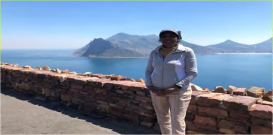
Dean Nomlomo organized and facilitated meetings to support my project. She sponsored a farewell get-together to further conversations with faculty (see photo below)
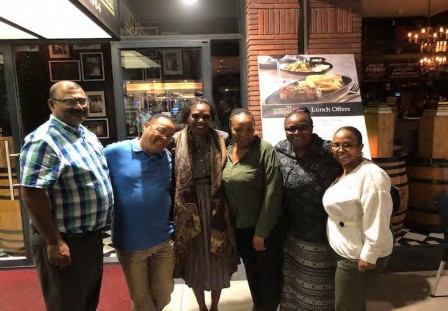
From right to left are: Faculty of Education Deputy Rajendran Govender, Mr. Frederick Sylvester (Department of Educational Psychology), Professor Ukpokodu (UMKC Visiting Scholar), Ms. Nonhlanhla Shandu-Omukunyi (Department of Language Education), Prof. Mokgadi Moletsane (Department of Educational Psychology) and Dean Vuyokazi Nomlomo.
Many thanks to Dr. Trevor Moodley (my collaborator) and his wife for going above and beyond to support my visit—the morning rides to campus, the project support, the lunches, constant encouragement, and family gift. I am especially grateful to his wife for the ride to campus when Dr. Moodley had a schedule conflict, and we were caught in a heavy traffic that caused her to go late to her appointment. My sincerest gratitude to Professor Harold Herman (Emeritus) for his relentless efforts to make my UMSAEP dream a reality. I am most grateful for his Ubuntu spirit—taking time off his busy schedule to pick up my apartment keys in advance (since I was arriving at midnight), coming to the airport to pick me up and moving my suitcases to the apartment, and the essentials he and his wife packed for me—milk, coffee, sugar, fruits, pastries, to get me started before I found my way around—Thank you, Thank you! My deepest appreciation to the faculty who participated in my research.
Unfortunately, I cannot list their names, due to ethics protocol, but I deeply appreciate the time, the knowledge, and the passion they shared with me. My gratitude to the many faculty and staff who were hospitable, courteous, professional, and supportive. Special thanks to Mr. Steve Kemp in the Dean’s office, Ms. Rona Wales, Secretary to Dean Nomlomo, Ms. Brenda Wanza, Secretary in the Department of Educational Psychology, and the student worker in the Department of Educational Psychology who gave me an enlightening tour of the UWC beautiful campus.
Reviewed 2025-12-23